The GED Framework is a living, collaborative document continually refined through input from ADEE members and the wider dental education community.
Updates are guided by consensus, peer-reviewed evidence, and stakeholder feedback, ensuring the framework remains current and relevant. Anyone can suggest changes, which are reviewed by the GED taskforce and published live on the ADEE website.
How is the GED continually updated?
The GED Framework was designed for co-creation and co-ownership between ADEE and its members. As such, anyone is able to make suggestions for changes to the framework - and these will, in turn, be considered by the curriculum taskforce.
The taskforce is primarily informed by published and peer-reviewed curricula, which have been developed through consensus and open consultation
Once changes are accepted, these are updated live on the website.
How do I go about this process?
If you find errors or mistakes in the documentation, then please do let us know using this email address [email protected].
If you are wanting to make more substantial changes, then we recommend contacting the GED taskforce ([email protected]) so that ADEE can support you throughout the process.
Some examples of recent organisations and associations that have worked with ADEE in this way, include:
- British Prosthodontic Society – in publication
- European Society for Endodontology – outcome here
- European Federation of Periodontology – outcome here
- Erosive Tooth Wear Foundation – in progress
ADEE provides the opportunity to canvas member opinion, establish pan-European surveys and Delphi-style rounds of consensus - and in-person workshops at the annual conferences - to support curriculum development work.
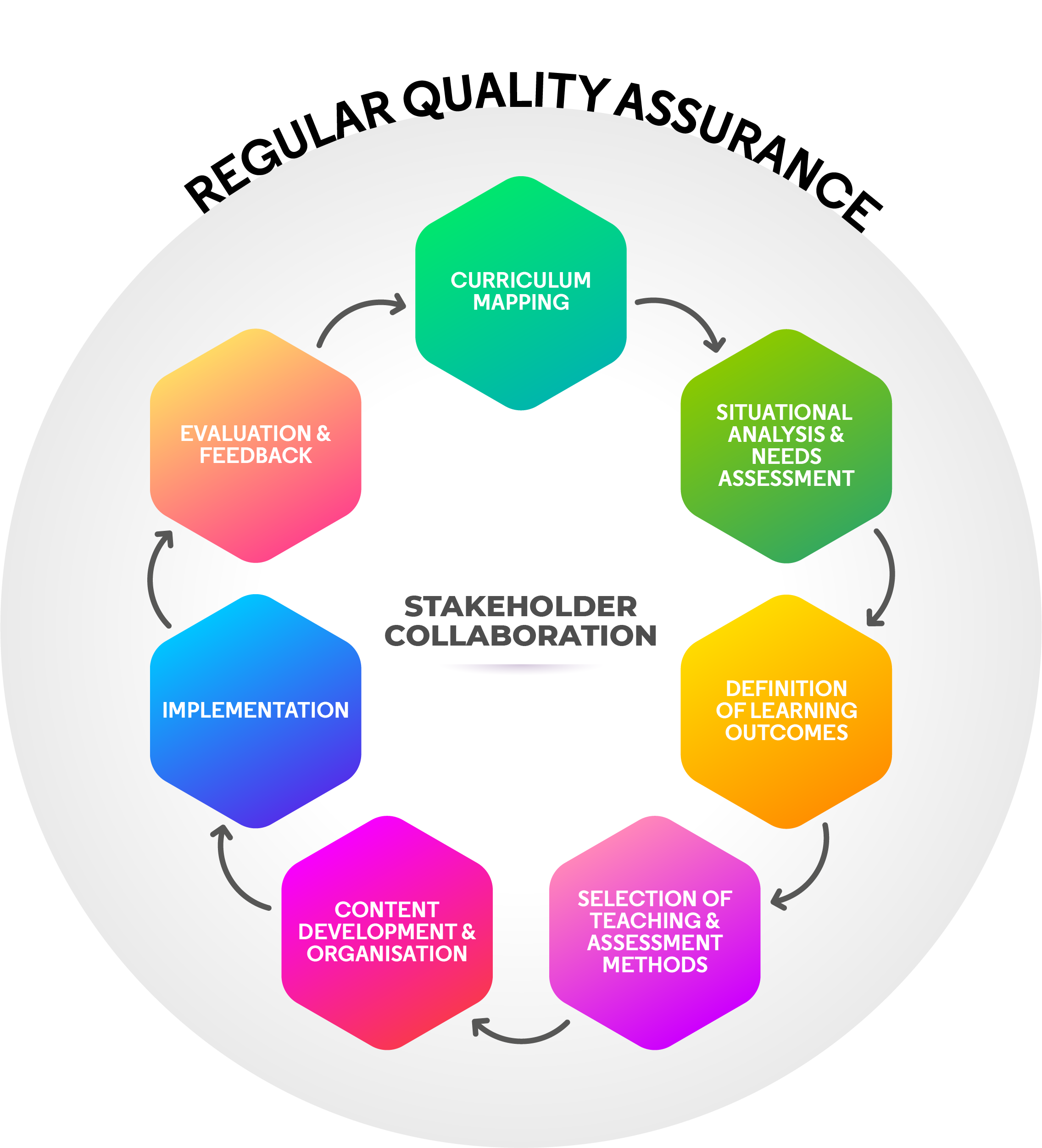
This paper by Dixon et al (2025) explains the process of curriculum development and provides examples of each stage through the lens of Sustainable Practice. Further, the clarification that can be sought from the educational community around clarity, importance, and difficulty of learning outcomes, is showcased in this paper relating to the development of Domain V.
Delphi approaches, and consensus vs. agreement
We are moving away from traditional Delphi-style approaches to curriculum development, which often require some learning outcomes to be excluded in order to reach consensus. Instead, we use a more inclusive approach that assumes all learning outcomes may have value. Rather than deciding whether an outcome should be included or excluded, stakeholders are asked to consider its level of importance within the curriculum by categorising it as essential, important, or aspirational.
This approach promotes inclusion while still supporting consensus. It shifts the discussion from the presence or absence of learning outcomes to their relative importance, helping educators position outcomes more effectively within their local programmes.
ADEE recommends that learning outcomes are offered out to open consultation (mediated via the GED team) - with the opportunity for participants to comment on the importance of each outcome (essential, important, aspirational), and how easy or difficult each outcome is, to teach/assess. Given that the importance judgement has three possible options (E,I,A), the GED taskforce believes that reaching 50% or more responses in a single category would suffice to represent general agreement, or consensus.
Future work of the development group should employ educator experts to focus on determining effective and accessible methods of teaching and assessment in relation to the outcomes that were identified as more challenging.
Some examples of such outcomes are linked below:
- GED Domain V - Research - Teaching and Assessment Guidance (in-press)
- GED Domain V - Research - Embedding Research in modern dental curricula (in-press)